Resolve PR_END_OF_FILE_ERROR: VPN, Antivirus & Profile Fixes
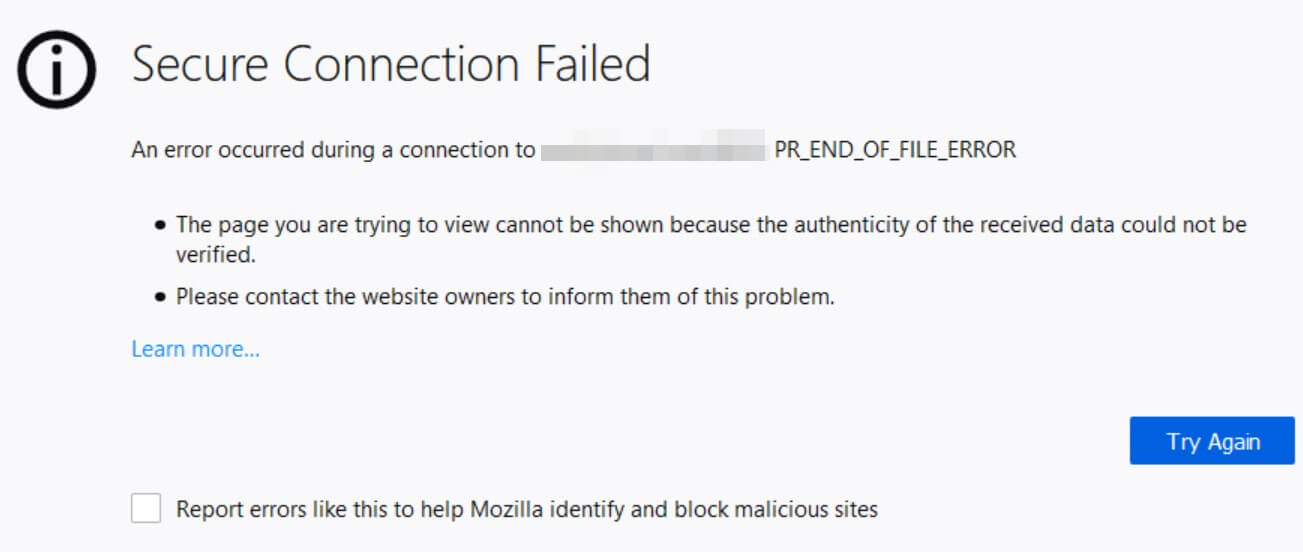
Encountering the PR_END_OF_FILE_ERROR can be a frustrating experience for any internet user, especially when it disrupts your browsing on Mozilla Firefox. This particular error message, often accompanied by the stark warning "Secure Connection Failed," signals a fundamental breakdown in your browser's ability to establish a safe and encrypted link with a website. While seemingly obscure, understanding and addressing this error is crucial for maintaining seamless and secure online activity. This comprehensive guide will delve into the intricacies of the PR_END_OF_FILE_ERROR, explore its primary causes, and provide a systematic approach to resolve it, focusing on common culprits like VPNs, antivirus software, and corrupted browser profiles.Deciphering the PR_END_OF_FILE_ERROR: What It Means for Your Browser
At its core, the PR_END_OF_FILE_ERROR indicates that Mozilla Firefox failed to complete the essential handshake required for a secure connection. When you attempt to visit a website protected by Transport Layer Security (TLS) or its predecessor, Secure Sockets Layer (SSL), your browser and the website's server engage in a complex negotiation process. This involves exchanging "cipher suites" – a sophisticated set of algorithms that dictate how authentication, encryption, and data integrity will be handled during the session. If Firefox cycles through its available cipher suites and cannot find a compatible or supported set of instructions from the website's server, or if the connection is abruptly terminated before this negotiation is complete, the PR_END_OF_FILE_ERROR is triggered. Imagine trying to speak with someone who only understands French, but you only know German, and your translator is suddenly absent or misconfigured. The communication breaks down, and in the digital world, this translates to a "Secure Connection Failed" message. While relatively uncommon compared to other browsing errors, its ability to prevent access to potentially *all* secure websites makes it a high-priority issue requiring immediate attention. For a deeper dive into the mechanics of this issue, you might find PR_END_OF_FILE_ERROR: Understanding Firefox's Secure Connection Issue particularly insightful.Common Culprits Behind PR_END_OF_FILE_ERROR
Understanding the root causes of the PR_END_OF_FILE_ERROR is the first step towards an effective resolution. While seemingly an issue confined to Firefox, the problem often lies in external interferences or internal browser misconfigurations.- VPN or Proxy Server Interferences: Virtual Private Networks (VPNs) and proxy servers are designed to route your internet traffic through their own servers, often encrypting it in the process. While beneficial for privacy and security, a misconfigured or overly aggressive VPN/proxy can interfere with Firefox's ability to establish a direct, secure connection. They might block essential security certificates, intercept traffic in a way that Firefox doesn't trust, or use their own cipher suites that conflict with the website's requirements, leading to the secure connection failing and the Pr End Of File Error appearing.
- Aggressive Third-Party Internet Security Solutions: Antivirus software, firewalls, and other internet security suites are vital for protecting your system. However, some programs employ "HTTPS scanning" or "web shield" features that intercept and re-encrypt secure connections to scan for threats. If this interception process is flawed, or if the security software's certificates are not properly trusted by Firefox, it can prevent a legitimate secure connection from forming. The antivirus might deem a safe site "dangerous" or simply fail to correctly re-establish the encrypted link, causing the error.
- Corrupted Firefox Profile: Your Firefox profile stores all your personal data, including bookmarks, browsing history, saved passwords, extensions, and specific browser settings. Over time, or due to software conflicts, this profile can become corrupted. A damaged profile might contain incorrect or conflicting secure connection settings, rendering Firefox unable to properly handle TLS/SSL handshakes, thus triggering the PR_END_OF_FILE_ERROR across multiple sites.
- Incorrect SSL/TLS Configurations: While less common for the average user, modified system-level or browser-specific SSL/TLS settings can lead to this error. This could involve an attempt to enforce outdated or unsupported cipher suites, or a conflict with modern security protocols used by websites. Such modifications might occur due to other software installations or manual tweaks, causing a mismatch with the current web standards.
- System Date and Time Discrepancies: Although not explicitly mentioned in all diagnostics, an incorrect system date and time can wreak havoc on secure connections. TLS/SSL certificates have validity periods, and if your system's clock is significantly out of sync, your browser may incorrectly perceive a valid certificate as expired or not yet valid, thus refusing to establish a secure link.
Step-by-Step Fixes for PR_END_OF_FILE_ERROR: Addressing VPN, Antivirus & Profile Issues
Resolving the PR_END_OF_FILE_ERROR often involves a systematic approach, isolating potential interferences and resetting problematic configurations. Here are detailed solutions to get your secure browsing back on track. For a more comprehensive guide on fixing Firefox-specific issues, consider reading How to Fix PR_END_OF_FILE_ERROR in Firefox: A Complete Guide.1. Reviewing Your VPN and Proxy Settings
VPNs and proxy servers are frequent culprits behind secure connection failures. It's essential to determine if they are the source of your Pr End Of File Error.
- Temporarily Disable Your VPN/Proxy: The simplest first step is to completely disable your VPN software or proxy server. If you’re using a browser extension for a proxy, disable that too. Then, attempt to access the problematic websites. If the error disappears, you’ve found your cause.
- Check Firefox Proxy Settings: Even without active VPN software, Firefox might be configured to use a proxy.
- Open Firefox and type
about:preferences#generalinto the address bar. - Scroll down to the "Network Settings" section and click "Settings...".
- Ensure "No proxy" is selected, or if you legitimately use a proxy, verify its settings are correct.
- Open Firefox and type
- Experiment with VPN Settings: If your VPN is essential, try switching to a different server location or protocol within your VPN client's settings. Some VPNs offer "split tunneling" or features to exclude certain applications; try excluding Firefox from the VPN's protection to see if it resolves the issue.
2. Taming Third-Party Security Software
Antivirus and firewall programs, while protective, can sometimes be overly zealous, leading to the PR_END_OF_FILE_ERROR by interfering with secure connections.
- Temporarily Disable Antivirus/Firewall: Disable your antivirus software and firewall (both third-party and Windows Defender/Firewall) for a few minutes. Retest Firefox. If this fixes the error, your security software is the likely culprit. Remember to re-enable them immediately after testing.
- Adjust HTTPS Scanning or Web Shield Settings: If your security software was the cause, look for features like "HTTPS scanning," "SSL inspection," "Web Shield," or "real-time protection" within its settings. Disabling these specific features, rather than the entire program, might resolve the issue while maintaining overall protection.
- Add Firefox as an Exception: Most security suites allow you to add specific applications as trusted exceptions. Add Firefox to this whitelist to prevent the security software from interfering with its processes.
3. Tackling Corrupted Firefox Profiles
A corrupted Firefox profile can store bad configuration data that prevents secure connections. Creating a fresh profile or refreshing Firefox often resolves this.
- Create a New Firefox Profile:
- Close Firefox completely.
- Press
Windows Key + R, typefirefox.exe -P, and press Enter. This opens the Firefox Profile Manager. (On macOS, open Terminal and type/Applications/Firefox.app/Contents/MacOS/firefox -P). - Click "Create Profile..." and follow the prompts to create a new, empty profile.
- Set this new profile as the default and launch Firefox. Test if the Pr End Of File Error persists.
- Refresh Firefox: Firefox has a built-in "Refresh Firefox" feature that restores the browser to its default state while saving your essential information like bookmarks, history, passwords, and cookies.
- Open Firefox, type
about:supportinto the address bar, and press Enter. - Click the "Refresh Firefox..." button on the top right.
- Confirm the action. Firefox will restart with a fresh profile.
- Open Firefox, type
4. Investigating SSL/TLS Configurations and Browser Settings
Sometimes, the issue lies directly within Firefox's or your system's secure connection handling.
- Check System Date and Time: Right-click on your system's clock, select "Adjust date/time," and ensure "Set time automatically" and "Set time zone automatically" are enabled. Sync your clock manually if needed.
- Update Firefox: Ensure your Firefox browser is up to date. Outdated versions may lack support for newer TLS protocols or contain known bugs. Go to
Help > About Firefoxto check for updates. - Clear Browser Cache and Cookies: Corrupted cache files or cookies can sometimes interfere with site loading. Go to
History > Clear Recent History, select "Everything" for the time range, and check "Cache" and "Cookies" before clearing. - Reset `about:config` Settings: If you've previously tweaked advanced settings, some might be causing conflicts.
- Type
about:configinto the Firefox address bar and accept the warning. - Search for settings related to `security.tls.version.min`. Ensure it's set to its default value (usually
1for TLS 1.0 or3for TLS 1.2, depending on Firefox version). - You can also right-click any modified (bolded) preference and select "Reset" to revert it to default.
- Type
5. Other Essential Troubleshooting Steps
- Start Firefox in Safe Mode: Firefox Safe Mode disables extensions and hardware acceleration, which can help determine if an add-on or graphics driver is causing the Pr End Of File Error. Go to
Help > Troubleshoot Mode...and select "Restart". - Reinstall Firefox: As a last resort, a clean reinstallation of Firefox can resolve deeply embedded issues. Make sure to back up your profile data beforehand, then uninstall Firefox, delete any remaining program folders (often in `C:\Program Files\Mozilla Firefox` and `C:\Program Files (x86)\Mozilla Firefox`), and download the latest version from the official Mozilla website.